Article
How to Find Official Information About an Anime Whose Korean Title Has Changed Multiple Times
 0
0
 0
0
An anime may appear under several Korean titles because different broadcasters, distributors, seasons, theatrical releases, or streaming services used different names. This does not always mean that one title is wrong.
The practical goal is to identify three things: the exact Japanese work, the Korean title currently used by the relevant licensed service, and the earlier titles connected to previous releases. Once these are separated, it becomes easier to search for the anime, purchase the correct edition, or cite it accurately.
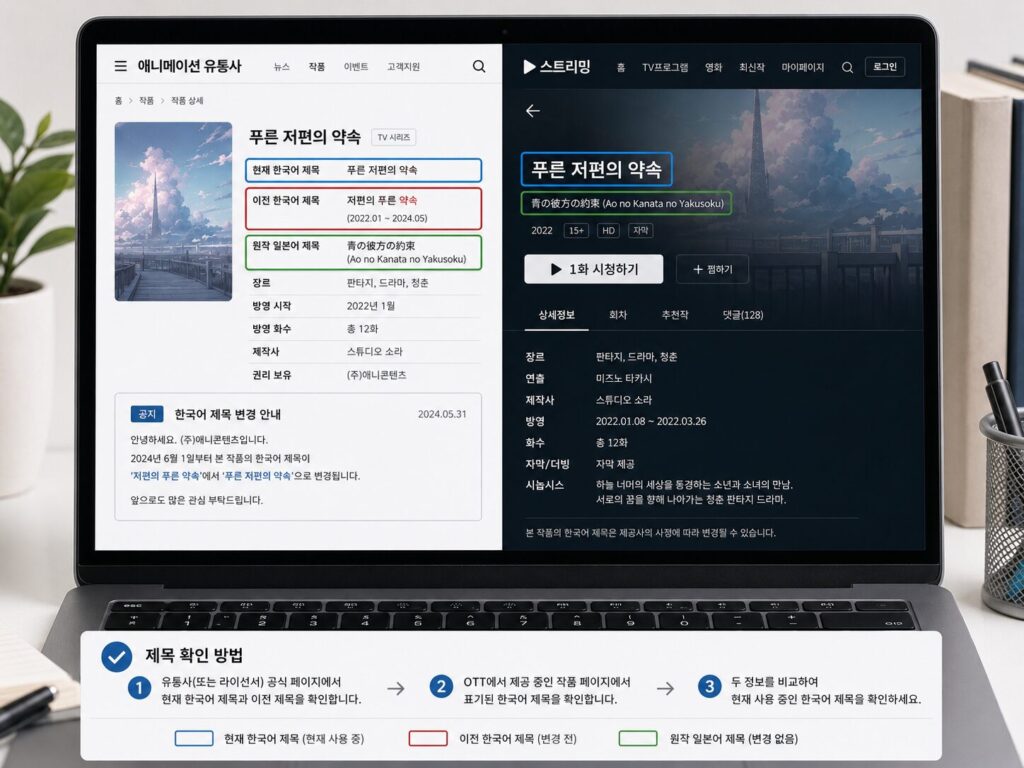
Confirm the Exact Anime Before Comparing Korean Titles
Begin with the original Japanese title rather than one of the Korean translations. Record the Japanese spelling, release year, season or film number, and format.
This prevents confusion between a television series and its film adaptation, different seasons with similar subtitles, remakes, and unrelated works that received similar Korean names.
Use the official Japanese anime website, publisher page, production-company page, or opening and ending credits to confirm the original title. If the anime was adapted from a manga or light novel, also check whether the anime title differs slightly from the source material.
Create a basic identity record:
| Information | What to record |
|---|---|
| Original Japanese title | Exact Japanese spelling |
| Release | Year and season |
| Format | TV series, film, OVA, or special |
| Original creator or publisher | Used to distinguish similar works |
| Korean titles found | Record each title without deciding yet which is correct |
Search for every Korean title together with the Japanese title or release year. Searching only one Korean name may hide older broadcasts, discontinued streaming pages, or physical editions released under another title.
Build a Title History From Official Korean Sources
Do not expect one website to show the complete title history. Use several official sources and identify what each one actually proves.
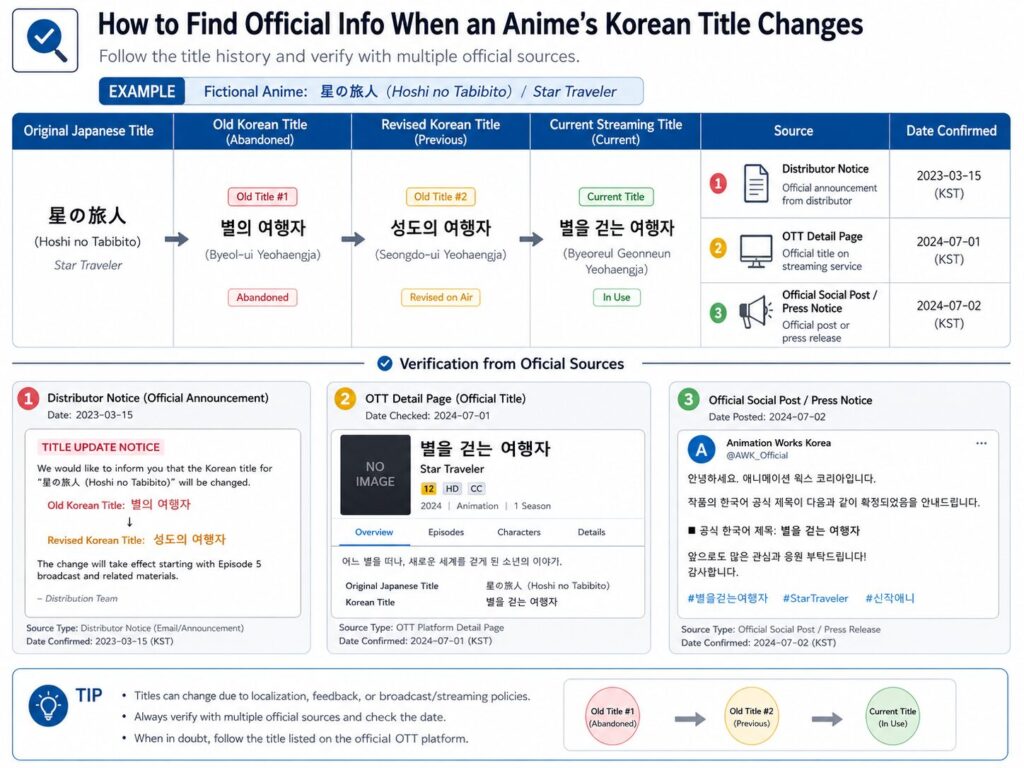
A current Korean licensor or distributor page is usually the best place to confirm the title used for the present release. A dated notice announcing a new season, rebroadcast, home-video release, or title correction is especially useful because it connects the title with a specific date and product.
Licensors may distribute the same anime to several television, IPTV, and OTT services. ANIPLUS, for example, states that it supplies licensed anime across broadcasting, IPTV, cable, and major OTT platforms. This means a licensor’s current announcement can sometimes explain a title more clearly than a single streaming listing.
The anime’s current OTT detail page is the next source to check. It confirms the name being used on that service now, but it does not necessarily prove that the same title was used for every earlier broadcast or edition.
Laftel explains that most of its anime is supplied after Korean rights importers secure the relevant licences. It also announces newly added works through its website and official social account. Therefore, a Laftel title should be treated as the official display name for that licensed listing, while the importer’s notice may still be needed to reconstruct earlier name changes.
For anime films or classified video releases, the Korea Media Rating Board’s classification search can provide another dated record of the Korean title submitted for that release. However, the title in a rating record establishes the name used for that particular classified version; it should not automatically be treated as the only valid title for every season, platform, or product.
Use this evidence order:
| Source | What it confirms | Main limitation |
|---|---|---|
| Current licensor or distributor notice | Title connected to a licensed Korean release | Older pages may no longer be available |
| Official broadcaster or OTT detail page | Current title on that service | May not explain previous names |
| KMRB classification record | Title used for a specific classified release | May cover only a film or video edition |
| Official social post | Dated announcement or correction | Posts can be difficult to search later |
| Reliable press report | Third-party record of an official statement | Should not replace the original announcement |
Record the title, source, release type, and checking date. Do not invent a reason for the change. A new title may reflect a new licence, season, translation choice, branding decision, or metadata correction, but the reason should be stated only when an official notice confirms it.
Decide Which Korean Title to Use
The correct title depends on what you are trying to do.
When searching for where the anime is currently available, use the title shown on the current licensed Korean platform. Also search the previous Korean titles and original Japanese name because older metadata may still appear in search engines or episode listings.
When purchasing a disc, ticket, digital episode, or merchandise, use the exact title printed on that edition. An older Blu-ray released under a former title does not become incorrectly labelled merely because a later distributor adopted a new name.
For an article, catalog, fan database, or academic reference, use the current verified Korean title first, followed by the original Japanese title. Former Korean titles can be included as aliases with their approximate periods or releases.
A clear record may look like this:
| Period or release | Korean title | Source |
|---|---|---|
| First television broadcast | Former Korean title | Broadcaster schedule or archived program page |
| Later licensed release | Revised Korean title | Distributor notice |
| Current streaming listing | Current Korean title | Official OTT detail page |
| Original work | Japanese title | Official Japanese website |
If two current official services still use different Korean titles, do not force one universal winner. State which title each platform or distributor uses and identify the version, season, or territory involved.
When the conflict affects a purchase, publication, or metadata correction, contact the current Korean licensor or platform. Provide the Japanese title, release year, season, both Korean names, and screenshots of the conflicting pages. Ask which title applies to the exact release you are documenting.
Conclusion
The safest way to identify an anime’s Korean title is not to choose the most common search result. First confirm the exact Japanese work, then construct a dated history from the current licensor, official Korean platforms, classification records, and title-change notices.
Use the current platform title for present availability, the title printed on a specific edition when purchasing it, and both the current and former names when documenting the anime’s history.


